
Plants in New Hampshire: Plants Legal Status Guide

- 1. What does plants decriminalization in new hampshire entail?
- 2. Medical plants in new hampshire
- 2. a. Does new hampshire give protection for out-of-state patients?
- 2. b. Can a medical patient drive under the influence of plants?
- 2. c. Do medical patients get protection at the workplace?
- 3. Attempts at recreational plants legalization
- 3. a. The first-ever endorsement by the senate
- 3. b. Annulment of plants-possession charges
- 4. Final thoughts
In contrast to every other New England state, New Hampshire has yet failed to legalize the recreational use of plants, and its medical plants laws remain among the most restrictive in the nation. Although possession of small, personal-use amounts has been decriminalized, the fines aren’t exactly low, and repeat offenders may still face misdemeanor charges. Read on to find all there is to know about plants policy in New Hampshire.
What Does Plants Decriminalization in New Hampshire Entail?
In 2017, New Hampshire’s legislature passed a bill that removes misdemeanor charges for persons caught with 21 grams (3/4 ounces) of plants or less. The offender only has to pay a $100 fine for the first two offenses and $300 for the third offense. You don’t really have an option of not telling the officer your name – instead of avoiding the fine, you’ll be arrested. Also, if it’s your fourth offense within a 3-year period, you will be arrested and charged with a misdemeanor.
The same rules apply to plants concentrates, such as extractions, but the upper limit is 5 grams instead. As for plants-based products, such as edibles, drinks, etc., you won’t get punished for something considered a personal-use amount – a definition of which is left at the discretion of the law enforcement.
Plants-smoking paraphernalia are actually less tolerated in New Hampshire than the substance itself, and theoretically, you can be facing up to 1 year in prison and up to a $2,000 fine. However, we believe that such severe punishment is reserved for selling paraphernalia rather than simple possession of them.
Another legal consequence a plants smoker faces is the suspension (or denial) of the driver’s license: it can be from 90 days to one year for offenders over 18 and 1-5 years for those younger than 18. We’ve summed up some of the most common low level offenses in the table below:
| Offense/Limits | Maximum Jail Time | Maximum Fine |
|---|---|---|
| Possession of Dry Flowers | ||
| up to 3/4 oz, 1st/2nd offense | None | $ 100 |
| up to 3/4 oz, 3d offense | None | $ 300 |
| up to 3/4 oz, 4th offense | None | $ 1,200 |
| 3/4+ oz | up to 1 year | $ 350 |
| Possession of Concentrates | ||
| up to 5 g, 1st/2nd offense | None | $ 100 |
| up to 5 g, 3d offense | None | $ 300 |
| up to 5 g, 4th offense | None | $ 1,200 |
| 5+ g | up to 1 year | $ 350 |
| Sale/Possession with Intent to Sell | ||
| up to 1 oz | 3 years | $ 25,000 |
| 1 oz - 5 lbs | 7 years | $ 100,000 |
| 5+ lbs | 20 years | $ 300,000 |
If you’re wondering how the cultivation of plants is punished, it’s treated the same way as possession, and the amount includes the total dry weight of the plants you’ve been growing.
Medical Plants in New Hampshire
New Hampshire legalized medical plants in 2013, but the law has many restrictions, and the main one is a very limited number of cases when plants-based medicine may be recommended. Basically, medical plants is seen as the last line of defense for when every other, “legitimate” therapy has failed to address a serious debilitating condition or terminal illness. However, starting in 2017, some other conditions have been added, including chronic pain, PTSD, and hepatitis C. This trend is likely to continue.
At the moment, the list of eligible medical conditions is as follows (but please bear in mind that besides being diagnosed with one of these, the patient must show very severe symptoms):
- Alzheimer's disease
- Amyotrophic lateral sclerosis
- Autism
- Cancer
- Chronic pain
- Chronic pancreatitis
- Crohn's disease
- Glaucoma
- Hepatitis C
- HIV/AIDS
- Insomnia (moderate to severe)
- Multiple sclerosis
- Muscular dystrophy
- Nausea
- Post-Traumatic Stress Disorder (PTSD)
- Spinal cord disease or injury
- Traumatic brain injury
- Wasting syndrome*
| *Please note that this is by no means medical advice to self-administer plants. However, if you're a resident of New Hampshire and have one of the conditions on the list, you may speak with your doctor about trying plants to treat the disease or its symptoms. It's up to the medical professional to decide if the use of medical plants in your case is warranted. |
|---|
Another restriction is that New Hampshire forbids its patients to grow their medicine or procure it from any other source but licensed dispensaries, which in New Hampshire are called ATCs, or Alternative Treatment Centers. A patient or their designated caregiver with a valid medical plants card can legally possess up to 2 ounces of plants. This amount is considered a 10-day supply.
Currently, there are legislative initiatives to raise the possession limit, include new medical conditions, and allow patients or their caregivers to cultivate plants at home.

Does New Hampshire Give Protection for Out-of-State Patients?
It does, but many unanswered legal questions remain, such as ‘What happens if the out-of-state patient possesses more than NH’s legal limit of 2 oz but less than his/her own state’s legal limit?’ or “What if the out-of-state patient’s medical condition, for which they use medical plants, isn’t eligible in NH?”.
Another legal gray area would be the source from which the patient obtained their medicine: most other states allow the patients to grow their own supply of plants, so does it mean they can bring it with them to New Hampshire? The answer is probably no, as the visitors to the state are supposed to buy their medicine at a dispensary with their out-of-state card.
All these questions are more pressing since NH is surrounded by ‘legal’ states and has a common border with Canada.
Can a Medical Patient Drive Under the Influence of Plants?
It’s illegal to be impaired by plants and drive – just the same as with any other prescription drug that can affect a person’s ability to operate a vehicle.
The issue with plants, however, is that there’s no chemical test that can tell with any certainty if the driver is actually impaired or not, since in heavy medical users, the levels of strength in their system can be quite high long after they stop feeling any psychoactive effects. The police have to show that the driver is incapacitated by plants use and can’t drive safely.
Do Medical Patients Get Protection at the Workplace?
The issue with workplace drug testing – when it comes to plants – is the same as with roadside testing: the chemical test itself isn’t enough to demonstrate impairment. A joint smoked on a weekend will be enough to fail the drug test during the next workweek. On this ground, medical patients, who by definition are protected from discrimination at the workplace, successfully contest the results of a drug test in court.

Attempts at Recreational Plants Legalization
In contrast to many other states where plants has been legalized through a popular referendum, New Hampshire relies on the will of the legislators in such matters. The state's legislators haven’t been immune to the changes, but they so far have failed to reach a consensus as to how the adult-use legalization should look like.
The first attempt to legalize plants was made as far back as 2014, and the initiative went as far as the preliminary vote but eventually died on the floor of the House of Representatives. Since then, there have been several similar proposals by the House, but the state’s Senate remained the stumbling block for every attempt at reform.
The First-Ever Endorsement by the Senate
The 2024 marked the pivotal moment for plants policy in the Granite State, as for the first time in history the Senate passed a heavily amended bill that would legalize possession of plants by adults and create a system of sales through privately-owned but state-controlled franchises.
The outgoing Governor Chris Sununu insisted that the number of these franchises be limited to 15 for the entire state. This scheme closely mirrors the one that N.H. has for liquor sales – they are only permitted in a limited number of state-controlled stores. Interestingly, this proposal has wide enough public support – 60% of New Hampshire residents spoke in favor of the franchise system, according to the polls.
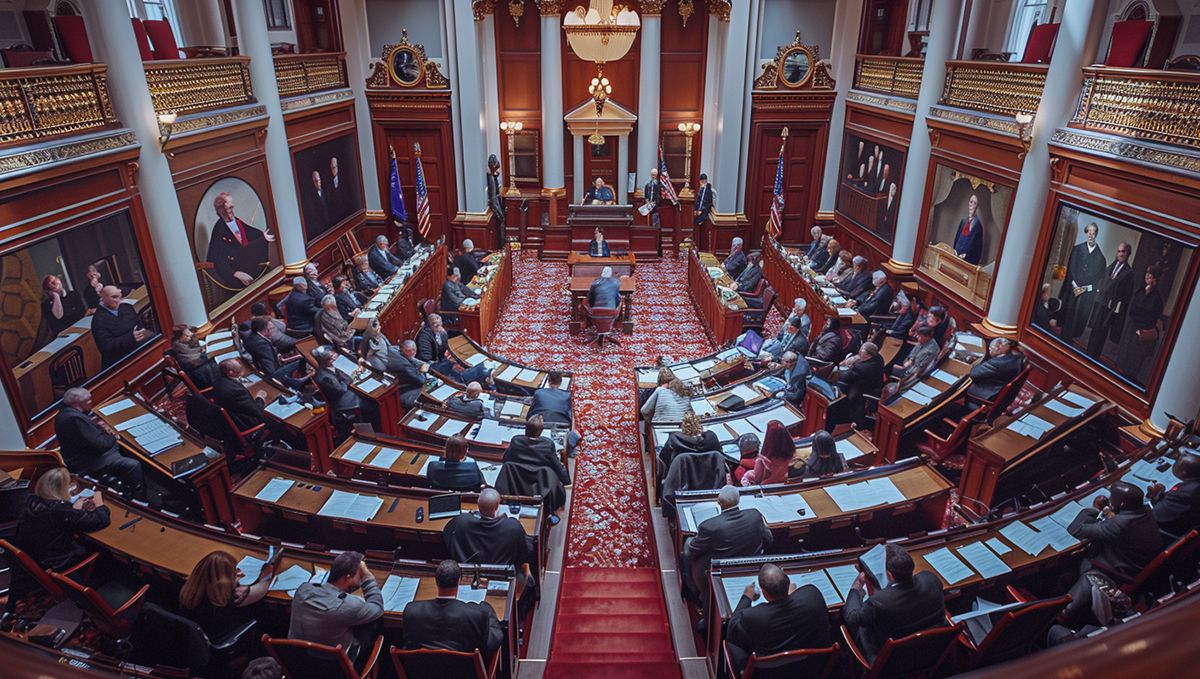
The bill was passed to the House which had the option of rejecting it, accepting it, or calling a bicameral conference committee to try to reach a compromise. They chose the latter option, but the committee failed to come to an agreement, and the legalization of recreational plants in New Hampshire was postponed again.
Meanwhile, arrests for plants in N.H. continue, with more than a thousand plants smokers arrested for simple possession in 2021 alone. The current Republican candidates for the governor’s office staunchly oppose adult-use legalization, while Democrats speak in its favor.
Annulment of Plants-Possession Charges
Among several initiatives proposed after the failure of the last plants-legalization proposal, is a bill that seeks to annul all convictions for the plants-related crimes that are now considered non-criminal offenses. This same proposal would also initialize a process of resentencing for all other plants offenses.

Final Thoughts
New Hampshire still remains rather conservative when it comes to the question of plants legalization, but, unless something happens to reverse the national trend, the reforms in the state are inevitable. The opposition of the Senate has been overcome for the first time in years, and polls show that the majority of the state’s residents want to see plants legalized. In the meantime, plants smokers are advised to remain cautious as they are still facing fines for simple possession and use of the substance. Stay safe!
Comments