
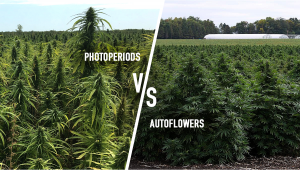
Photoperiod vs. Autos - Which One's Better?

- 1. What are photoperiod plants plants?
- 2. What are auto plants plants?
- 3. What are the differences between photoperiod and auto plants seeds?
- 4. In conclusion
The plants industry is evolving more than anyone could have imagined. With new seeds, concentrates and oils making it into the market each day, you’re spoiled for choices. But, one question that constantly pops up in every grower’s mind is: Photoperiod or autos? Which one should you choose?
The photoperiod vs. autos debate isn’t new. Growers have taken their sides and arguments are rampant everywhere. While you could grow both types, the goal is to choose something more effective. And this article will help you do just that. Autos returned very little but nowadays you can find auto seeds that can return and produce as much ok as photos in just under 9 weeks, making it possible to grow outdoors all year long.
Here’s an easy way to understand the development of auto seeds: Just think about vegetables. This might seem like an oversimplification, but it all boils down to breeding and plant science. If you have a serious green thumb, or simply enjoy growing one or two vegetables each season, you’ll have some experience with seeds and cultivar quality. Take broccoli, for example. You’ll never find this vegetable in nature; it’s purely the result of selective breeding at the hands of humans. Broccoli started out life as a humble wild mustard plant, and humans created it by selecting large flowering heads and thick stems. In fact, most modern vegetables aren’t entirely “natural”.
Human breeders focused on the traits they wanted, put in some hard work, and produced attractive cultivars with long lists of traits that people want to nurture, grow, and consume. Most of the seeds available on the market are the result of breeders shaping traits, including size, taste, growing speed, and productivity—the same applies to plants. So, where does auto plants fit into this picture?
Auto plants stems from the same stream of logic. Breeders found new ways to produce more desirable plants. By locating and experimenting with plants that possess auto genes, breeders created hybs that boast the attractive traits of photoperiod seeds with much swifter growing times. Auto seeds truly offer the best of both worlds. So, why on earth wouldn’t you want to grow them? No longer do you have to wait several months to sample your return. Instead, autos are ripe for the picking in a matter of weeks! Now, you’re about to get to know these fast, productive, and revolutionary plants on a deeper level. Discover everything you need to know about auto plants, how it compares to photoperiod varieties, and why you need to get growing them!
1. What Are Photoperiod Plants Plants?
The term “photoperiod” comes up in any site selling plants seeds. Simply put, photoperiodism is the measurement of light the plant is exposed to. When talking about a photoperiod plant, the light and dark cycles are taken into account. This happens because photo plants plants will only start flowering once they get at least 12hs of darkness, which usually happens outdoors when winter comes or when you switch to 12/12 indoors. So, when you see a number such as 24/0, for instance, it typically means that the plant gets 24 hours of light and 0 hours of darkness.
In other words, it’s as simple as the sun rising and setting. Most photoperiod plants seeds will flower when they receive at least 12 hours of darkness as it happens in the wild. Growers let the plants grow for a certain duration in the vegetative stage. Usually, the plants run on an 18/6 cycle with 18 hours of light and 6 hours of darkness. However, the plant will continue to grow and refuse to flower until the season or light cycle changes.
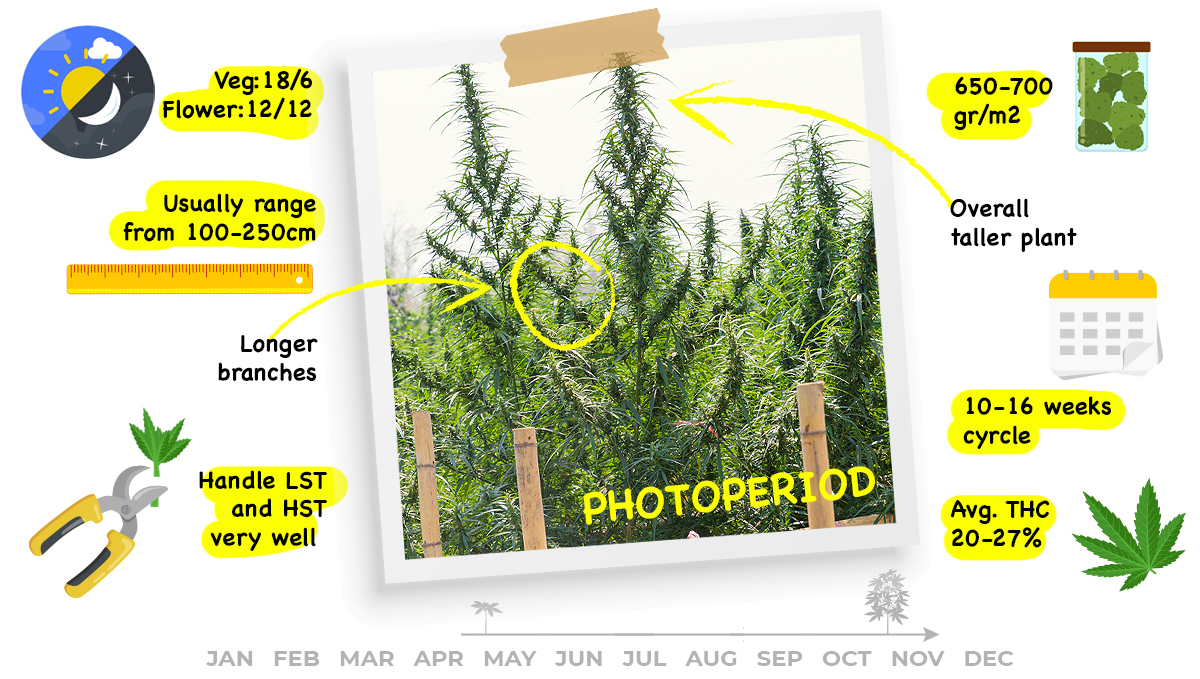
And this is why growers alter the light cycles and switch to 12/12 with 12 hours of light and 12 hours of darkness. The plants start flowering only when they receive a signal indting that the season is changing. Many growers get on well with photoperiod seeds. Many of these varieties, especially those that are genetically Sat-dominant, grow over 300cm and develop huge sprawling canopies—and big canopies mean big returns! However, they have some serious limitations. For example, most growers don’t have the space to let them reach their full potential if they want to grow indoors.
Furthermore, they aren’t the best option for outdoor cultivators looking to keep things private and stealthy. And, of course, they aren’t ideal for those growing in cooler climates further north that experience shorter summers. Without applying synthetic means of light deprivation, growers in these regions simply don’t have time to let large photoperiod seeds reach maturity before the first seasonal frosts come and eliminate their plants before they start producing okous colas. Other growers are put off by photoperiod plants seeds because they simply lack the patience. Some of these seeds require months of nurturing, watering, and feeding.
2. What Are Auto Plants Plants?
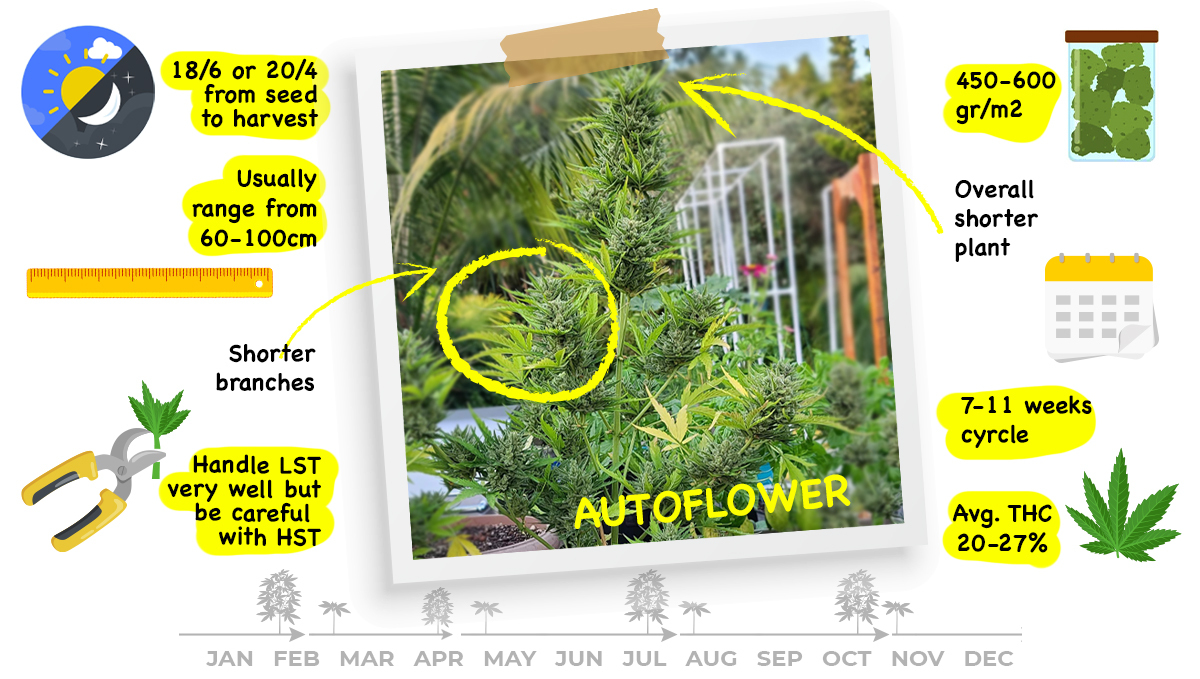
Unlike photoperiod plants, autos don’t depend on seasonal changes to begin flowering. After the plant develops a few branches, it begins to flower “automatically”, which is why they are named autos. Suffice it to say that autos will flower no matter what conditions you provide. Getting only 12 hours of sunlight? No problem – autos will still flower. Wanna complete the entire grow with a 12/12 cycle from start to finish? Sure! Autos will perform the same.
But where did the auto trait come from? And how did it end up in modern hyb varieties? Well, plants naturally spread far across the planet of its own accord before humans started migrating with seeds. Whereas some portions of the population headed further south from the origin point of Central Asia, others made their way up north, all the way to Siberia. Here, photoperiod plants didn’t fare well for the same reason that modern growers in these climates tend not to grow them. Their reliance on seasonal changes in sunlight exposure left them maturing far too late in the season and, thus, their genetic lineages were terminated.
But life adapts and overcomes. Surviving plants developed genetic mutations that enabled them to abandon photoperiodism and begin flowering based on an internal genetic clock instead. Those with these auto traits survived and thrived. Eventually, modern breeders saw value in these genetic phenoms. However, pure wildtype autos are nothing special in terms of return, potency, and flavor. So, growers decided to cross them to photoperiod varieties with better traits to produce hybs that offer both attractive traits and the auto gene.
Although autos tend to grow fine with less light, they use light to produce food. Therefore, autos grown in an 18/6 cycle generate more returns than those grown with minimal light. This means that you can grow autos indoors under any light cycle you prefer or outdoors all year long but the quality and quantity of your return will be affected by the amount of light your autos get. Now, you can grow autos under the following light cycles:
- 12hrs of light and 12hrs of darkness:
- Or 18hrs of light and 8hrs of darkness;
- Or 20hrs of light and 4hrs of darkness.
But have in mind that you will definitely have better returns and more okous buds when growing under 18/6 or 20/4 but you can still get a decent return if your plants get 8, 10 or 12 hours of light per day.

3. What Are The Differences Between Photoperiod And Auto Plants Seeds?
The primary difference between photoperiod and auto plants is the exposure to light where autos flower automatically. We already got that out of the way. But, there are other differences and we will discuss them below.
Autos are fast
Autos are regarded for their speed. Most autos take only 2 months from seed to return whereas photoperiod seeds need at least 4 months to complete their cycle. This is one of the reasons beginners choose autos. For example, if you grow a photoperiod seed, it needs at least 8 weeks in the vegetative period to grow to a certain extent. Once the grower is satisfied with the growth of the plant, he can shift the plant from the vegetative to the flowering phase by altering the light cycle.
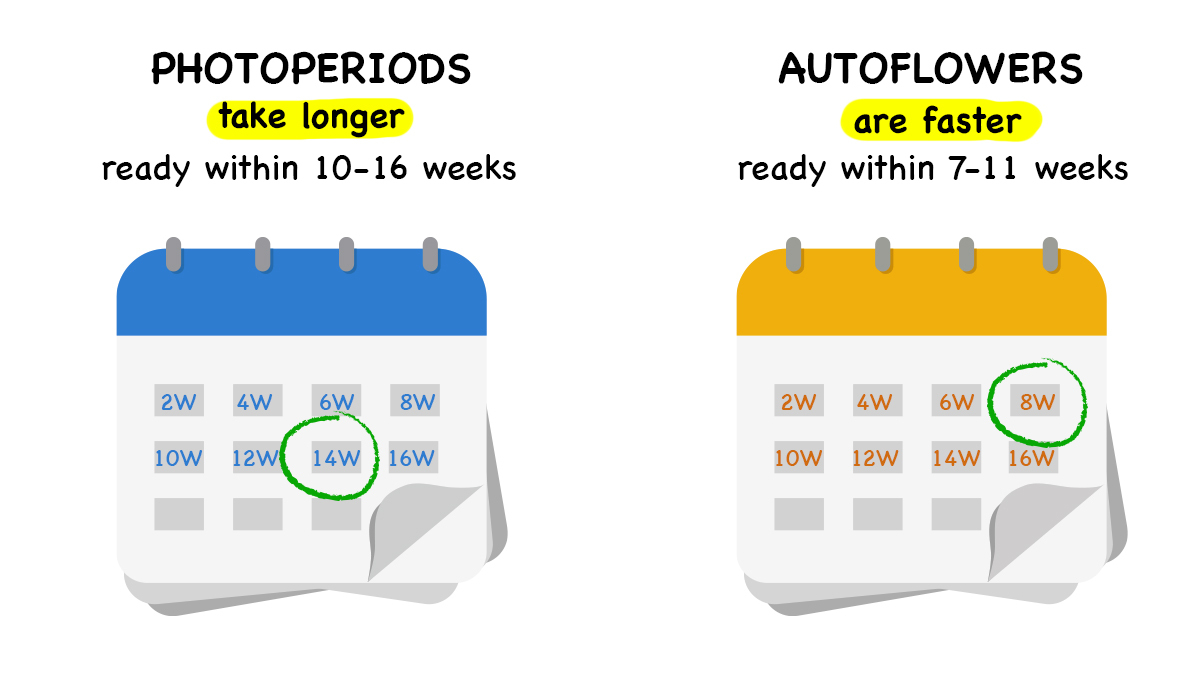
Autos, on the other hand, start flowering as soon as they turn 4-5 weeks old. They are so fast that the grower needs to keep up with it; however, after a few returns, it becomes incredibly easy because it’s as simple as sowing the seeds and forgetting about it. So, given a choice between smoking the buds in 3 and 5 months (including curing period) which one would you choose? Autos take 3 months and photoperiod plants need 5 months, and if you need something fast, autos seeds are definitely ideal for you.
This impressive level of speed comes in handy in several different growing situations. First, let’s consider the commercial growers. These cultivators grow plants to make money, so it makes sense that a fast turnover would help them to improve profit margins. From large growing operations in legal regions involving huge greenhouses to stealthy small-scale home growers, the speed of autos can help to kick-start a budding business. Secondly, this trait also greatly benefits those who grow for personal use, be that recreationally or medicinally. These people can keep the money they would spend in dispensaries or give to dealers and instead grow their own stash at home in a matter of weeks.
Size
Photoperiod plants take a long time to flower. They take more time to grow, and naturally, they grow bigger. On average, they grow up to 5-6 feet indoors. Outdoors, they grow as big as 9-10 feet. This is one reason why they need to be trained mandatorily. For instance, if your Grow Room lacks vertical height, growing photoperiod plants is not an option unless you train them using several training techniques.
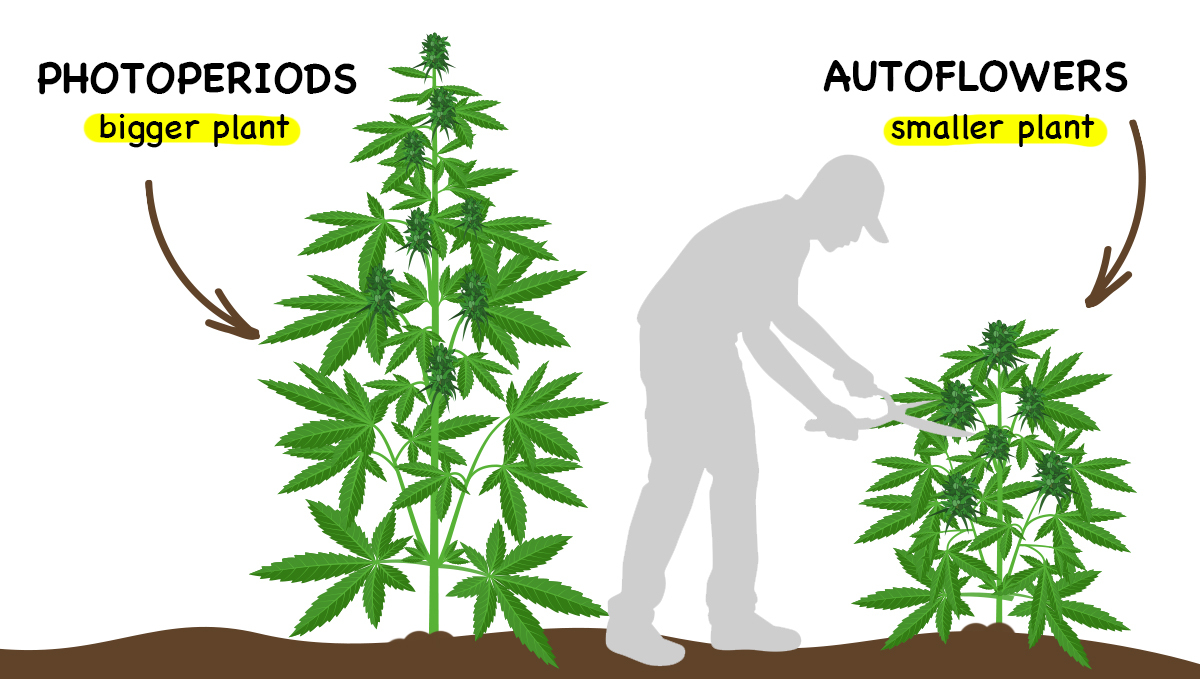
Even if your Grow Room is about 8 feet in height, lights and other equipment will reduce the height, thereby forcing you to choose smaller plants. Autos are genetically smaller. With such rapid flowering, an auto can grow up to 2-3 feet indoors while growing up to 5 feet outdoors. For growers with small grow rooms, autos can be a blessing in disguise. Since the plants are smaller, they are perfect for stealth grows as well. Training techniques such as LST and topping can be used to get better returns.
This trait is obviously extremely appealing to growers who are looking to maintain a low profile and keep their herbal hobby as secretive as possible. Whether you prefer to grow indoors or outdoors, the trait of a small stature makes autos perfect for the job. Indoors, clandestine growers have many options when it comes to growing small plants, from converted cardboard boxes to buckets and cupboards. Outdoors, small autos are great for guerilla growing. Not only are they hardier enough to fend for themselves in meadows and forest openings, but they rarely draw attention and lay low among the surrounding vegetation.
Maintenance
Photoperiod plants need to be maintained right from altering the light cycle to training the size to prevent uncontrolled growth. It can be maddening if you don’t install a timer. Also, photoperiod plants cannot handle light leaks at all. This is why some growers hesitate to make their own Grow Rooms because it’s a little difficult to build a grow room with absolutely no light leaks at all. But, what happens if there’s a light leak, you ask? Well, for one, a light leak can stress the plant and force it to turn into a hermaphrodite full of seeds. Since you want sensimilla buds with no seeds, a light leak is out of the question. As you can understand, you need to be precise with photoperiods and there’s no margin of error especially when it comes to the lighting.
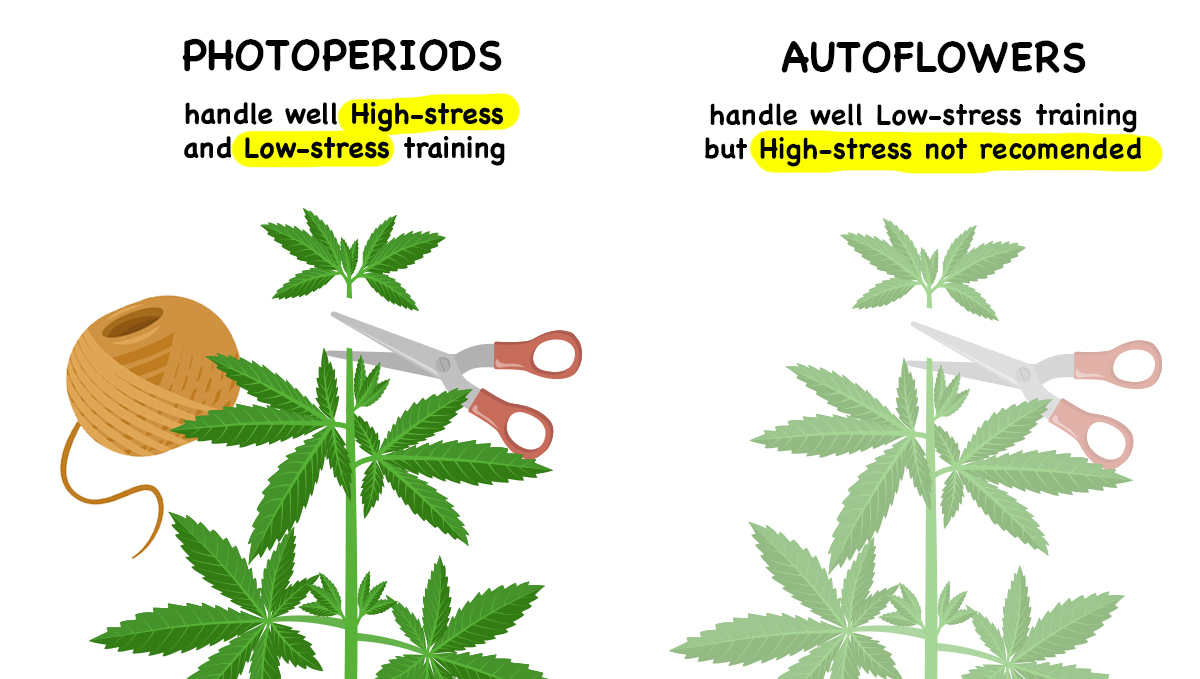
Also, the plant reduces returns considerably if it’s stressed, so it forces the grower to constantly worry about light leaks and other factors that stress the plant. Coming to autos, they are super hardy. Although every single day matters when they grow, they don’t need to be maintained much. Yes, it’s true that it’s easy to stunt an auto if something goes wrong early in the vegetative stage because they have a limited number of days, but they don’t mind light leaks at all. In fact, autos can be set with one light cycle – preferably 18/6 hours – and they will simply do their thing even if you leave them alone.
Potency
There was a big difference in photoperiod and autos when the first auto called Lowryder was released. Photoperiod plants seeds boasted of at least 15 percent strength back then and autos were no match for them.
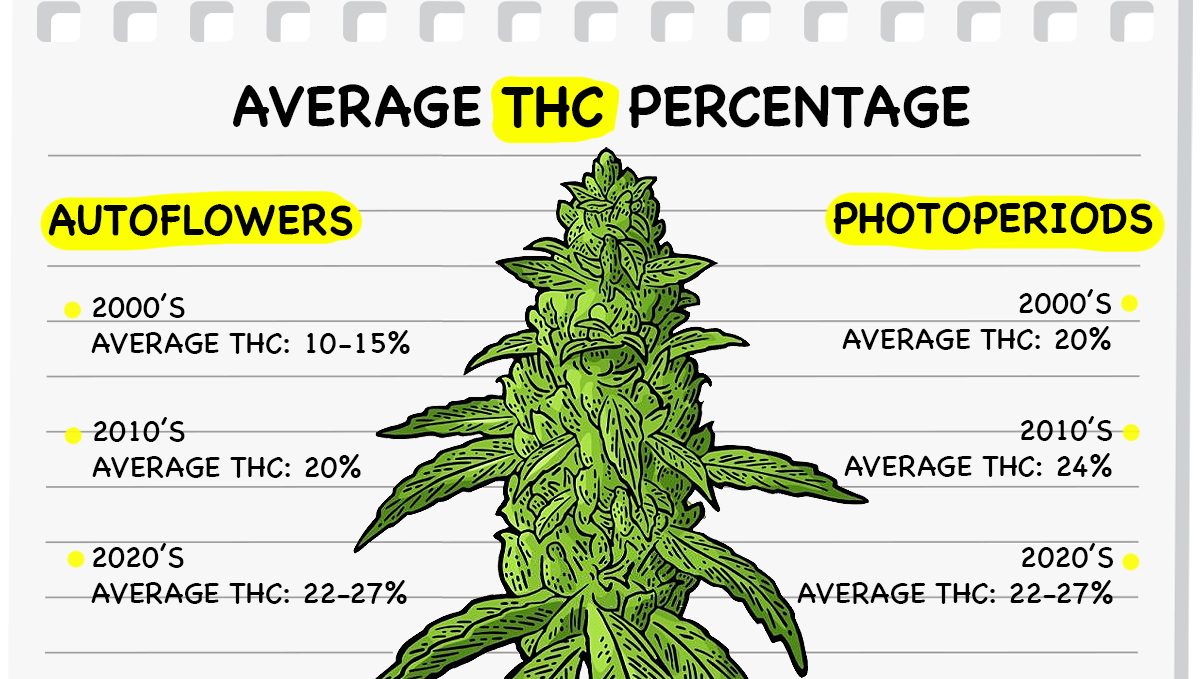
However, things have changed, and how! The autos released in recent years are every bit as potent as photoperiods. Take our Strawberry Banana Auto, for example. With over 27 percent strength, they are certainly as good as photoperiod plants. Some autos exceed photoperiod seeds in potency now! Yeah, that’s how far autos have progressed!
So, what does this all mean? Well, it gives growers and smokers a lot of choices. Ultimately, you’ll find an auto seed for any situation. The older and less potent varieties are still surprisingly popular. Why? Because they offer the most mellow smoke around. They offer a noticeable effect that isn’t too intense, which makes them perfect for wake-and-bake sessions and for use during the day. However, smokers are by no means limited to such subtle sensations. Modern varieties have the potential to blow your mind and even outcompete photoperiod seeds in many circumstances.
Return
Photoperiod plants are bigger – we have already established that. Obviously, the returns are more compared to autos. However, don’t write off autos just yet because you can grow two auto seeds in the time required to grow one photoperiod plant. To understand this in detail, let’s go a little deeper. Most photoperiod plants produce an average of 600-700 grams per meter square whereas autos generate about 450-550 grams per meter square. The returns increase if you grow them outdoors, regardless of whether they are photos or autos.
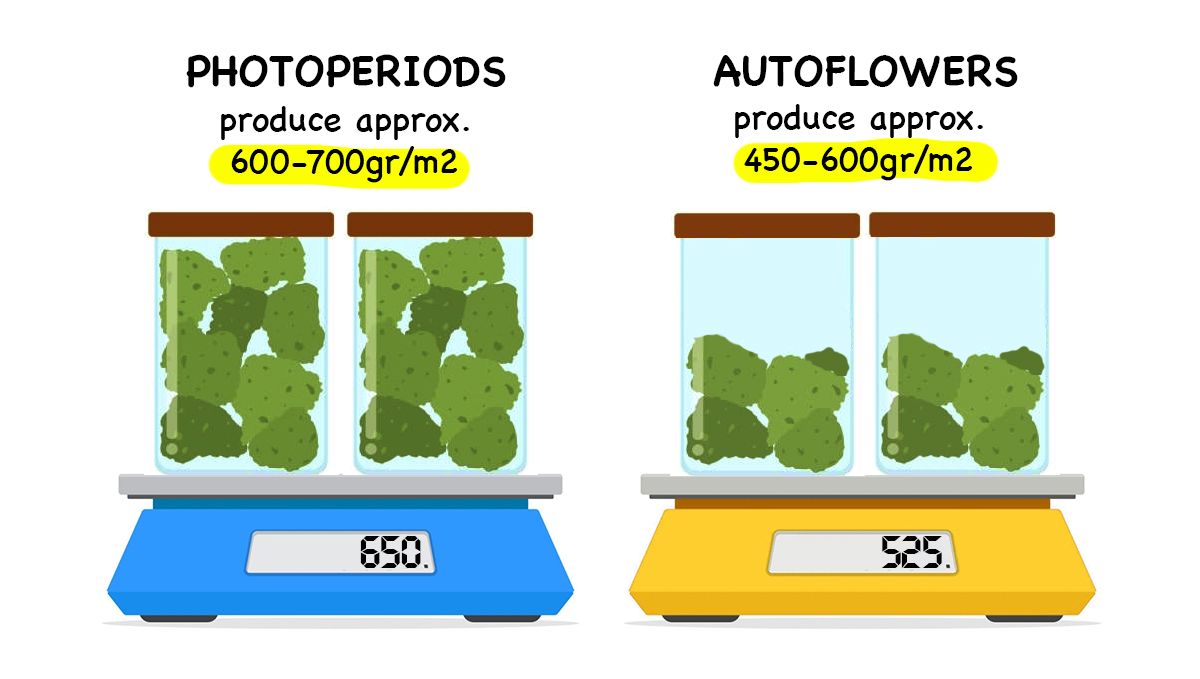
Some photoperiod plants produce at least 400 grams per plant while autos return up to 250-300 grams per plant. As you can see, photoperiod plants produce a bigger return. However, if you consider the time required to return a photoperiod plant and compare the two, the returns are pretty much the same. Let’s say you grow photoperiod plants and return 700 grams per meter square in 4 months. Within the same time duration, you can grow two batches of autos returning 550 grams per meter square per return. So, if you consider the time, the returns of the autos are higher than the photoperiod plants! Also, the size of the autos allows you to stuff more plants in smaller grow rooms, thereby producing more returns in the process.
Cloning
Cloning is the process of creating another plants plant using one plants plant as the mother. Photoperiods have an advantage over autos where they can be cloned several times. Therefore, a single seed can produce as many plants as you want.
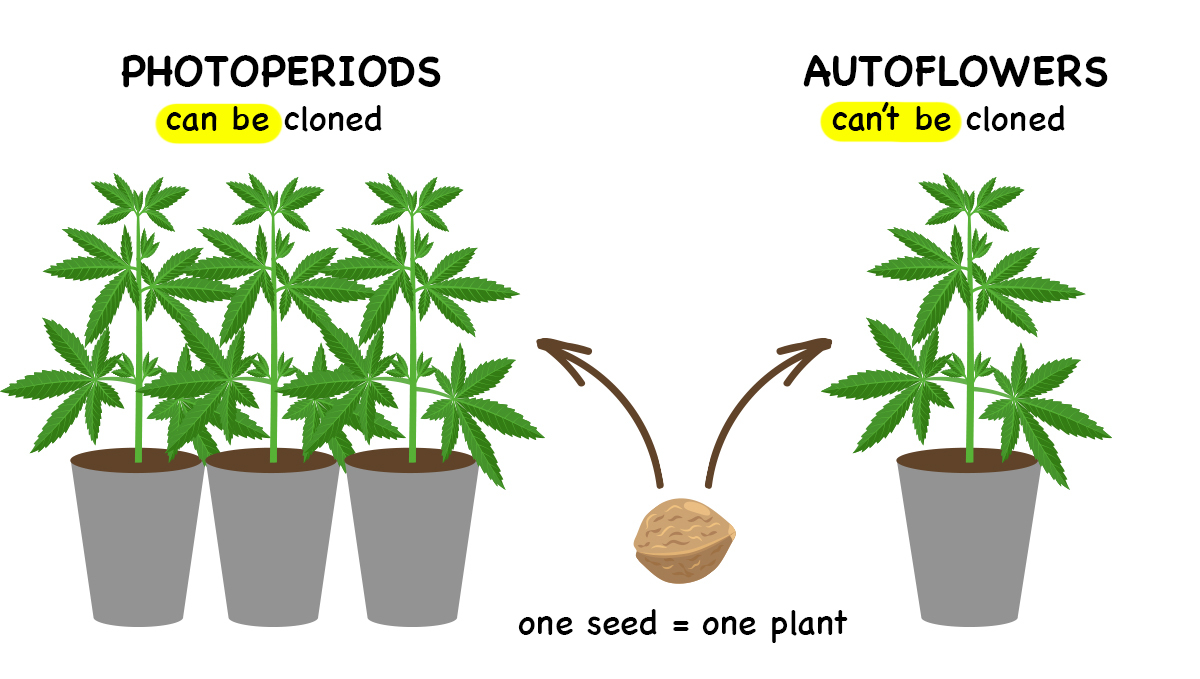
Autos can be cloned too, but it’s a waste of time and effort since the clone is of the same age as the mother. So, even if you clone an auto, the resulting plant will begin flowering immediately and you’ll be left with a tiny plant returning almost nothing. Remember, autos mature and switch to flowering based on an internal genetic clock. This all goes back to how this subtype of plants evolved in the short-growing seasons of Siberia. Even if you take a clone from a three-week-old plant, it’ll only have around nine weeks to establish a root system and develop flowers. Even if it works, you’ll be left with a very dismal return at the end of all of your effort. Although possible, we highly recommend that you avoid cloning autos, unless you want to as a personal experiment.
Perpetual returns
Autos have an advantage over photoperiods where they can be returned perpetually, as long as you want to. Sure, you can try the same with photoperiods but you will need two separate rooms for vegetative and flowering phases because the light cycles need to be matched appropriately. The same applies to cloning too. Even if you clone a mother plant, you’ll need to wait until the clones grow well to put them in the flowering stage. Why? Because you can’t push the clones into flowering stage immediately, and both the mother and clone will need to wait in the vegetative phase in an 18/6 cycle. This is why growers separate the clones and use different rooms for flowering and vegetative stages.
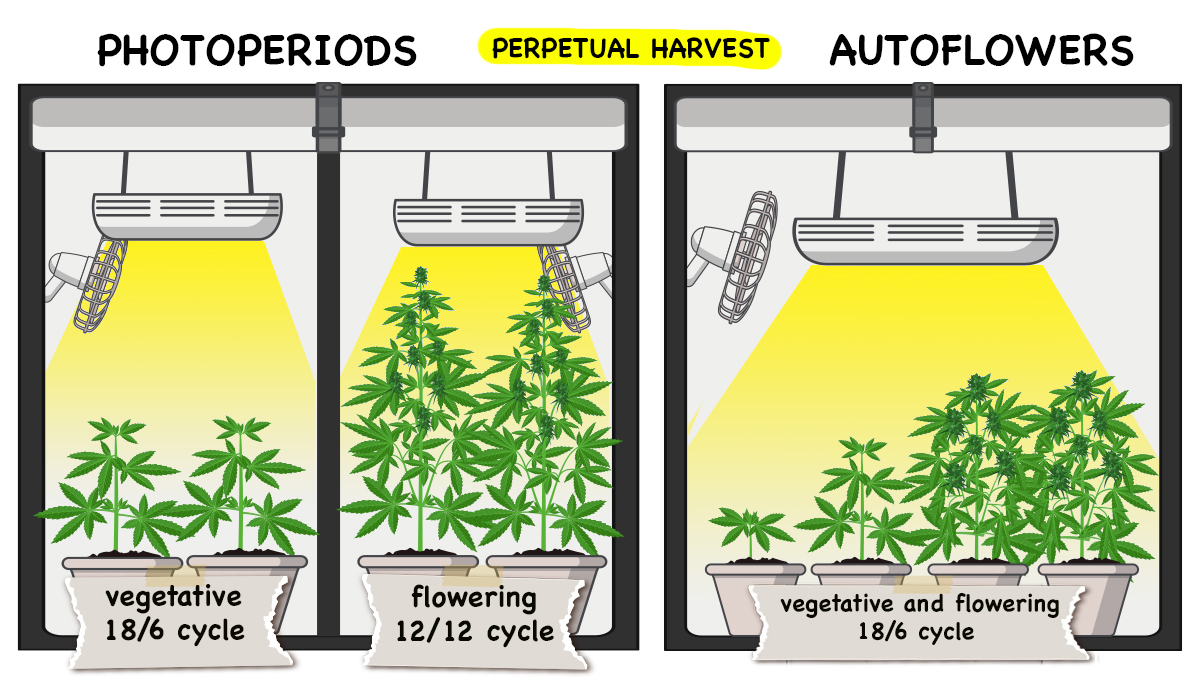
On the other hand, autos don’t need separate rooms since they don’t need specific light cycles. You can sow seeds and tend to the seedlings just as one batch is about to be returned, thereby saving you loads of time. Comparing both photoperiod and autos, it’s easy to see that autos match photoperiod plants in every aspect. Whether it’s potency or return or speed, autos have an edge over their counflavorarts. Having said that, it’s a matter of personal choice, but if you love smoking buds quickly, autos beat photoperiods by a long stretch.
| Differences Between Photos And Autos | ||||
|---|---|---|---|---|
| Average Size | Seed to return | Veg. Light Cycle | Flowering light Cycle | |
| Autos | 60-100cm | 7-10 weeks | 18/6, 20/4 | 18/6, 20/4 |
| Photoperiods | 80-200cm | 10-16 weeks | 18/6 | 12/12 |
4. In Conclusion
What used to be low-returning small plants have now evolved and improved a lot. Autos had a bad reputation due to the first auto seeds such as the Low Ryder not being at the same level as photoperiod seeds but nowadays you can find autos that are up to par with photos or even better. Good auto genetics can grow super okous flowers with huge returns, with strength levels reaching up to 27%, these plants allow you to grow top-quality flowers outdoors all year long and with a seed-to-return time of as little as 7 weeks, making them a great choice for those who suffer with challenging climates or those who just want a quick turnaround time without sacrificing returns of bud quality. If you’re looking for good auto genetics make sure you take a look at our catalog, with over 50 different seeds that vary in size, potency, and flavorene profile, you will surely find what you’re looking for.
If you’ve grown autos and photos before and want to share your experience with fellow growers, feel free to leave a comment in the comment section below!

Comments