
Plants Breeding: How To Create Your Own Plants Seed

- 1. The evolution of plants plants
- 2. Ind and sat landrace seeds
- 2. a. Plants ruderalis
- 3. Why create new seeds?
- 4. Plants traits and how to select them
- 4. a. What about the auto trait?
- 5. Trait inheritance
- 5. a. Dominant and recessive traits
- 6. The importance of testing for plants phenotypes
- 7. Plants seeds breeding techniques
- 7. a. Backcrossing
- 7. b. Selfing
- 8. Selecting female and male plants
- 9. Starting with your first generation cross
- 10. Testing your f1 crosses
- 11. A quick step-by-step guide on breeding plants
- 12. Breeding plants - faqs
- 13. In conclusion
Plants breeding takes a lot of time, basically consisting of breeding a male and a female plant, it can result in new seeds with unique characteristics. All you have to do is combine both plants plants’ genetics and refine it to get a unique hyb, but it’s not that simple. Have in mind that for most home growers, making new plants varieties can be extremely hard due to the experience and space needed to make good quality genetics, especially if you’re planning to commercialize your own plants seeds. But, if you want to make a seed for you to grow at home there’s no need to work that much, with just a couple of crosses you can make thousands of seeds to have your stock always full. So if you want to learn about plants breeding and making new seeds, read along!
1. The Evolution Of Plants Plants
Since the beginning, plants plants have bred naturally and possibly created multiple variations of the same variety but due to breeding randomly and not selectively, the outcome wasn’t a new seed but an improved version of the same genetics. For a few decades now, growers have been selectively breeding for high strength percentages for the psychoactive effects and most recently, for the medicinal benefits of Extract but there is much much more to plants breeding. There are many flavor and strength in plants that we haven’t studied or known about until recently and these can change the effects plants can provide, due to these discoveries, many breeders are now making varieties for other characteristics and not only strength and Extract levels.
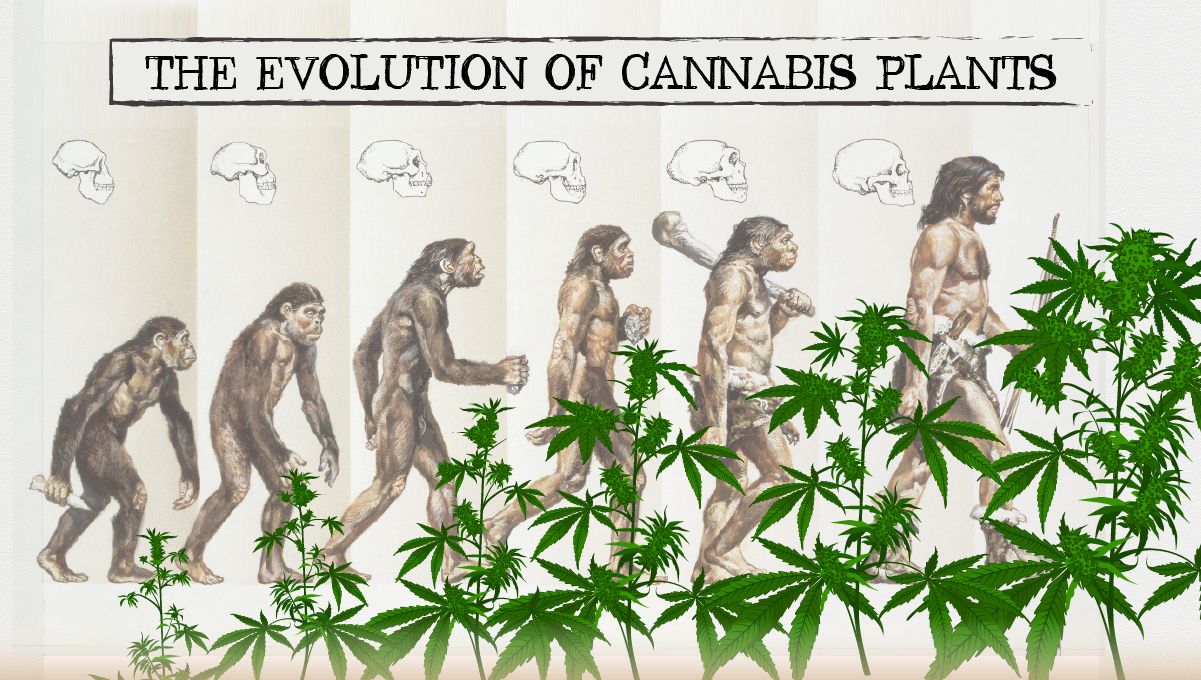
This means that there isn’t something such as the best seed in the world, for example, old-schoolers usually prefer the seeds available back in the 60s and actually prefer the effect those old seeds had despite not having super high strength levels as the seeds you can find nowadays.
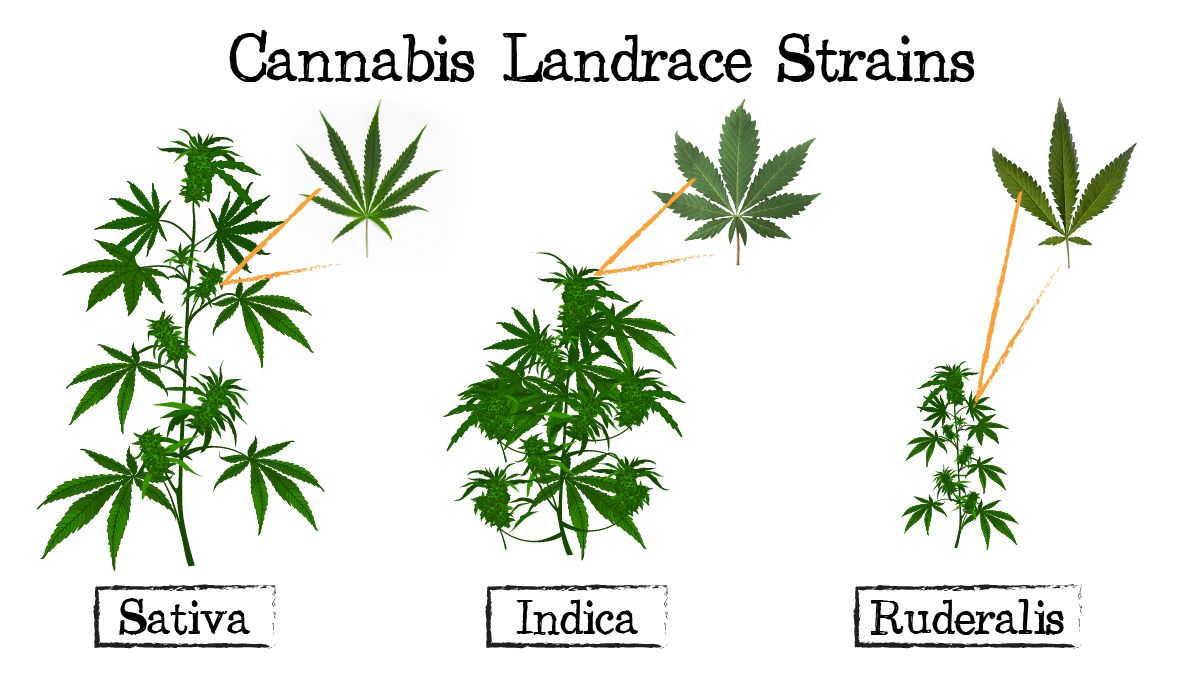
Luckily for us, many seed banks and breeders have preserved classic genetics and landraces and can now make modern genetics with older genetics or make modern seeds with similar characteristics to the old ones. Due to the increase in popularity plants has had during the last couple of years, you can now find hundreds of plants seeds with different effects, aromas, and cannabinoid content but don’t get mistaken, all plants seeds, including both old and modern genetics, come from the same plants plants: landrace seeds.
2. Ind and Sat Landrace Seeds
Before buying good-quality plants seeds was easy, growers traveled the world to find Ind and Sat landrace seed seeds to be able to improve the seeds they had and also make new seeds. These landrace seeds are seeds that naturally grow in a certain region and, often, the seed grown by locals. Due to being unique to a certain region, growers used to visit different places to find seeds with unique traits, such as color, taste, smell, or potency.
After finding the desired seeds, growers and breeders would breed them in order to pass those characteristics along to new seeds or seeds they were currently working on, which eventually gave birth to the seeds we know today. For example, it’s said that the famous OG kush was bred from Thai, Pakistani and Indian landraces back in 1992, and is still consumed nowadays, so this can give you an idea why landrace seeds are so important.
This practice of searching the globe for certain landraces has been undertaken by countless adventurous souls since the early ’70s (and possibly even earlier), but it has been best documented in the series “Seed Hunters”. Starting back in 2008, by breeders from Amsterdam set about searching the globe to identify, locate and retrieve plants landraces that have not yet been studied, and documented the whole process in a series of films.
The whole ethos behind these missions is to be able to supply scientists and doctors with the original plants seeds that have not become extinct with the main purpose being to enhance knowledge of the plants plant in the medicinal field. Every time a landrace seed goes extinct we lose the possibility of supplying the medical field with the unique and powerful properties that particular seed possesses. Once the scientific analysis has been completed, the seed is then released for breeding purposes.
Most of these films are readily available on YouTube. If you are interested in the process of plants breeding and the history of the plants plant (which you most likely are since you have landed on this page) then you should definitely give the Seed Hunter documentaries a watch.
Plants Ruderalis
Apart from Ind and Sat landrace seeds, there are Ruderalis landraces which weren’t very popular for breeding due to the effects not being as potent as Ind and Sat seeds but soon, breeders discovered that this plant had a unique trait, the auto characteristic, which means that Ruderalis could flower automatically regardless of light schedules.
The first ruderalis seed to be identified was found in southern Siberia by a Russian botanist D. E. Janischewsky in 1924. At the time, Janischewsky was in the region with the primary objective of studying wild plants seeds when he realized he had stumbled upon a third species separate from both Plants Sat and Plants Ind. He decided on the name “Ruderalis” as in botanical Latin the word means 'plantsy’ or ‘growing among waste’ which is exactly how he found this original Ruderalis seed to be. While this first example was found in Siberia, C. Ruderalis has since been identified in many other regions including Asia, Central and Eastern Europe, and throughout the Russian mainland.
The growth was much less vigorous than certain Sat and Ind landraces, with thin, weak stems and considerably fewer branches. He became interested in this new species and decided to start cultivating and studying the plant. He quickly realized that while the plants themselves are less impressive in terms of size and strength count than the other 2 species, they have the inbuilt genetic timer that automatically starts the flowering cycle, no matter the lighting. While Ruderalis seeds do have an inherently lower strength count than Sat or Ind seeds, they do have high amounts of Extract, which is one of the reasons (apart from the auto characteristic) why breeders became interested in them in the early 1980s.
When breeders realized that they could take advantage of the auto trait, they began breeding them with Ind and Sat genetics, resulting in auto seeds with high-quality buds and high potency. The first auto seeds weren’t very potent at all, but as time passed, breeders continued to develop them and now modern auto seeds are just as potent and beautiful as non-autos but have a major difference: the auto characteristic.
This is just one example of how breeding allows you to basically “take” a specific characteristic from a certain seed and pass it on to the offspring but despite sounding easy, it’s definitely not. If you’re planning on breeding your own seed there’s much more than just seeing something you like and pollinating a plant, as a breeder, you need to know how to identify the traits and know how to incorporate them into your seeds while being able to leave behind the traits that you don’t want.
It’s not as easy as it may seem though, with autos having a chequered history full of failures before the genetics got to the point we see them at today. While the exact origins of today’s auto seeds are still up for debate, most experts agree that the first verifiable, commercially available auto seed was “Lowryder” produced by breeder “The Joint Doctor”. While there had been decades of experimentation before this, nothing had hit the commercial market that was anywhere near interesting enough for the wider community to care about.
This seed was a cross between a Russian Ruderalis seed and a high strength-producing Mexican Sat seed, with the result being a more Ruderalis dominant phenotype lacking in psychoactivity and the full range of strength and flavor found in many auto seeds today. While Lowryder was derided for its lack of finesse and strength, it did not take too long before the “Lowryder 2” made its appearance on the scene. This seed was not only more potent but also came with a much more interesting flavorene profile. This was all that was needed for the wider community to become more interested in the idea of auto seeds, and is essentially what started the auto boom that we can thank for all the amazing auto seeds we have today!
3. Why Create New Seeds?
By now you might be wondering if there are so many seeds, why create new ones? Well, breeders make new seeds to potentially offer something that’s not available in the market currently.
Just like older seeds that had different effects than modern seeds, breeders could be starting a breeding project right now and the result may be, in some way, better than anything available today, even if they’re breeding with landrace seeds. This happens because every plant is a slightly different version of their brothers and sisters so the offspring will have a mix of characteristics from their parents and, as different varieties are combined together, there’s the potential to create new flavorene and effect combinations.

For example, hemp breeding has led researchers to find a new form of strength, Delta-8, which provides effects similar to regular strength but less potent, resulting in several new plants products. This genetic combination between two different species is called breeding and selecting a specific trait to pass along while leaving the unwanted characteristics behind is called selective breeding; This means that, in order to make a new seed, it’s just a matter of selecting the traits you want and the ones you don’t, and then breeding your variety to achieve that.
You won’t be able to create a unique seed by breeding a couple of different varieties, this is a hard task and there are several techniques to do so but before learning about these techniques, it’s important to know what characteristics a plants plant can have.
4. Plants Traits And How To Select Them
The first thing before you start the breeding process is to know the characteristics you want your plant to have; There are millions of combinations that could produce different results and it’s easy to get lost due to the different possibilities so it’s essential you establish your goals.
In the table, you can see the main characteristics that you should know before starting a breeding project, but there are more and, the bigger the genetic pool, the more options you will have but it also makes it harder to be able to maintain that characteristic. For example, when breeding for a specific color, it’s difficult to stabilize a seed so that the offspring has the color desired because, when breeding for colors, you may have to leave other desired characteristics behind.
In order to establish your goals you will need to have a breeding plan with the different characteristics you wish your seed to have, among these characteristics, the most common are:
| Plants Traits | ||
|---|---|---|
| Growth patterns | Hardiness | Buds |
| Tall or short | How fast it grows | Aroma |
| Bushy or with few leaves | Resistance to pests | Color |
| Flowering time | If it grows in hot or cold | Effects |
| Returns | Strength of branches and stem | Cannabinoid content |
Another example is when breeding for potency. When breeding for strength or Extract levels, you need to know that there are several aspects that can influence the effects and potency a seed will have, there are more than a dozen strength that haven’t been studied yet and flavor also play a huge role in the effects a seed has so you may be breeding for a high strength content but the result may not be what you wanted due to the flavorene profile or Extract content.
This means that you don’t necessarily need to breed for a high strength content for a potent effect, so it’s important to know all the characteristics and how one depends on the other. Also, have in mind that before starting your breeding project, you should already have parent plants that have the traits you want to be locked down or you will have to first breed the parent plants before starting with the new seed you want to breed.
What About The Auto Trait?
Breeding autos is the same as breeding photos but instead of crossing a photo to a photo seed, you cross photos with Ruderalis (or autos). In order to do this, you need to cross autos with photos for at least 4 - 5 generations for the majority of the offspring to contain the auto trait. The number of plants per generation varies from breeder to breeder but, in general, it's recommended to have a minimum of 100 plants per generation in order to be able to see all the characteristics the cross can exhibit and be able to select the best.
5. Trait Inheritance
Apart from knowing which traits you want your seed to have, it’s vital you know about dominant and recessive traits when breeding.
Dominant and Recessive Traits
Dominant traits are traits that will appear over recessive traits while recessive traits are characteristics that remain “hidden” until there’s a pair of the same recessive traits in the same plant, only then it will become evident. So for example, if you take two plants plants that the majority of the offspring develops green buds but a few grow purple buds, it means that there could be a recessive trait for purple buds in the genetics so, if you want to maintain the purple bud characteristic you will have to breed two of their offspring so the seeds carry a pair of the purple bud recessive trait and only then it will be present in all the plants.
Dominant and recessive traits can be really hard to understand so learning a bit about genetics and inheritance can give you a huge advantage when breeding plants plants. The first thing you need to understand is that all plants and animals get two versions of each gene, one from the father and one from the mother, and how they interact has a huge effect on your plant and the different phenotypes they can express. As mentioned, certain genes can be dominant, meaning that will always take over if the plant has one copy of the gene whereas recessive genes will only show up if your plant has two copies of the same recessive gene but in order for you to understand it better, here are some examples.
Complete Dominance
So for example, if a plants plant can have green or purple buds and the green bud genes are dominant, the purple bud genes are recessive and this means that the plant will show either green or purple buds, but will not mix the colors.
As you can see in the image below, where “G” is the dominant gene and “P” the recessive gene, all the offspring will express green buds even if the genetics also carries a purple bud gene in the first and second generation, but, as you continue to breed this will change.
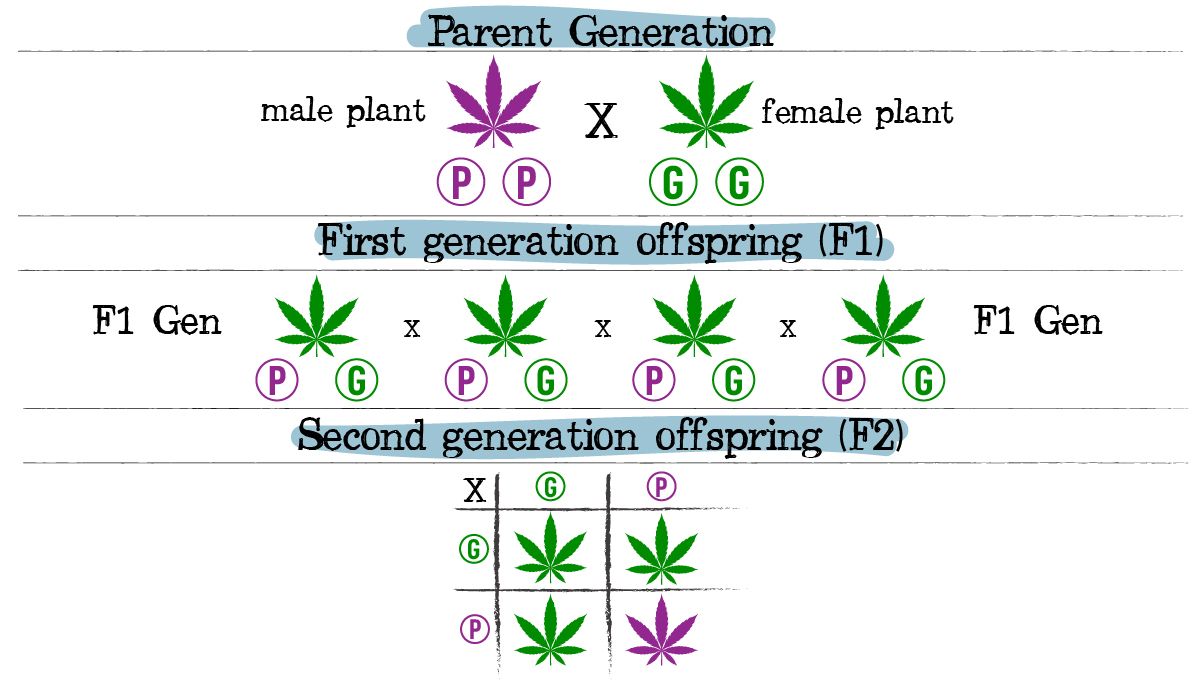
During the first and second generation, none of the offspring would develop purple flowers due to only containing one copy of the “P” gene but if you cross the F1 hybs together, then you would be incorporating genetics that contains more than 1 copy of the “P” gene (F2 generation), so 25% of the offspring would exhibit purple buds but, in many cases, it’s not that simple.
This happens because not all genes are dominant and recessive, in some cases, they can interact with each other to form new characteristics, and this is when incomplete dominance comes in.
Incomplete Dominance
Incomplete dominance happens when there aren’t any dominant genes to take over each other, instead of taking over, they affect each other partially. As you can see in the image below, if you were to start with two plants plants, one with “G” genes and the other with “P” genes and they display incomplete dominance, the offspring would not exhibit one or the other, but a mix of the two.
Unlike the image shown before, crossing these two genes with incomplete dominance would make the offspring exhibit pink flowers, this happens because neither version of the genes is completely dominant, so they actually create a mix of the two genes.
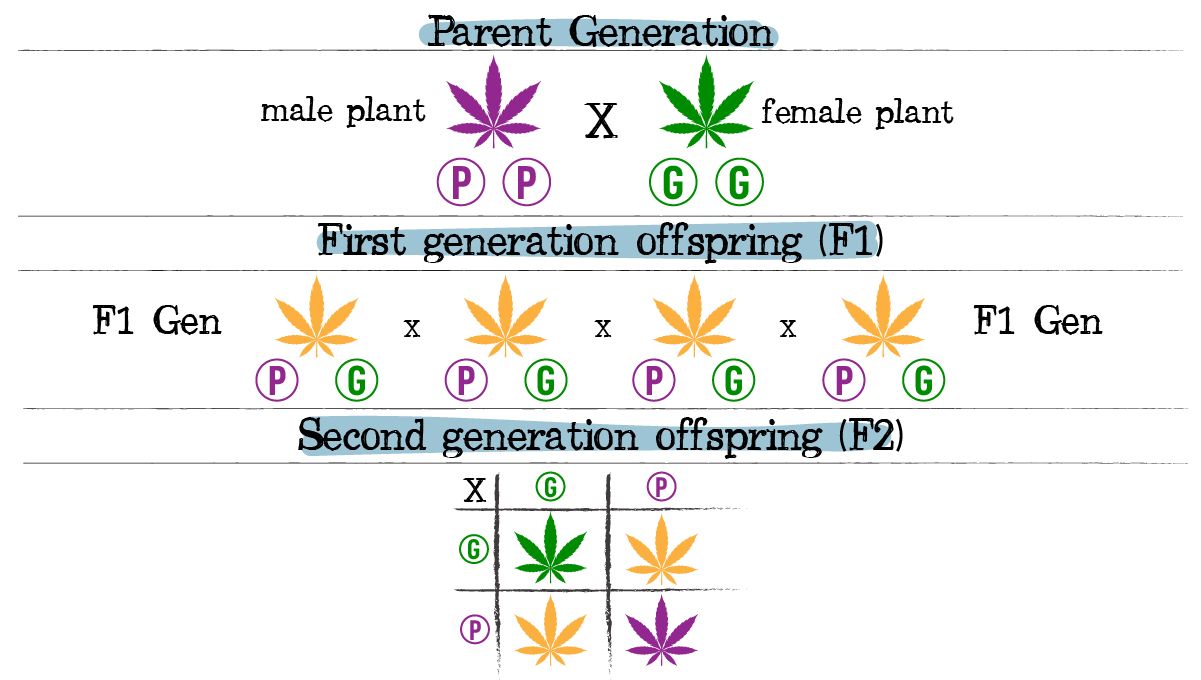
In this case, as you can see in the image, the first generation (F1 hybs) would only exhibit pink buds since the offspring would only get one copy of each gene and both of them cannot take over the other one, but if you crossed the first generation together, they will now have more copies of both genes (F3 generation), so you would get a 50% chance of getting pink buds and a 25% chance of getting green or purple buds. Now, obviously, this is just an example with bud colors but every single characteristic will be affected when crossing plants plants, from bud color and aroma to type of effect, and the best way to discover not only the dominant and recessive but also hidden genes, is to first cross the offspring to their parents (aka backcross) to see if new traits appear.
When you backcross, you’ll be able to see more and more variations the offspring can have, and this way you’ll be able to figure out which plants plants you need to breed together for the offspring to show the trait you’re going after. Once you’ve developed your genetics for some time, the traits will be more stabilized, and this way you can consistently breed for that specific trait (or traits) without having to start from scratch. But before the traits are more stabilized, the offspring will show several different traits and these traits will also vary depending on the environment the plants plants are grown in….so, what does phenotype mean?
6. The Importance Of Testing For Plants Phenotypes
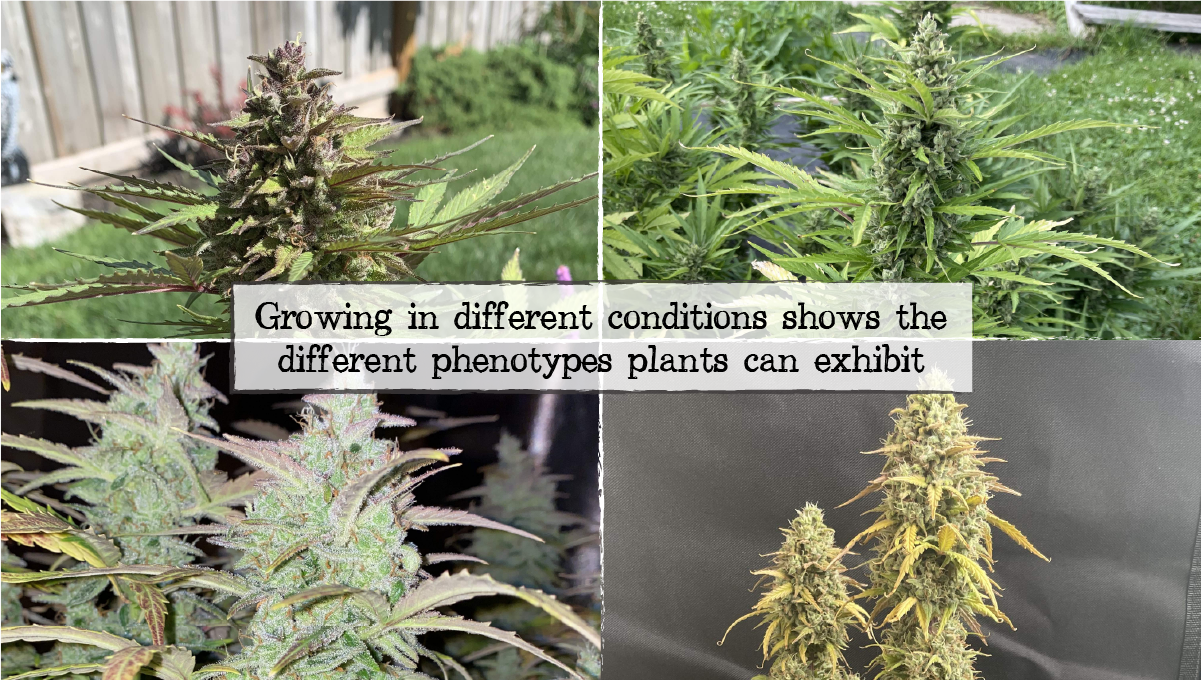
A phenotype is basically one gene combination out of the several traits a certain seed can exhibit, which includes all the traits mentioned in the table in topic 4. The traits (or phenotype) a plants plant expresses are influenced by the environment they’re grown in, this means that:
Genetics + Growing Environment = Phenotype
This is why you can grow the same seed indoors and outdoors, for example, and get different results. Despite not being the same, you can think of it as the characteristics kids get from their parents. For example, imagine two parents, if one is tall and the other very short then the kids have chances to grow tall or short but if both parents are tall, then the chances of the kids being tall are higher, and this is how phenotypes work with plants plants. Unstabilized seeds usually exhibit more than one phenotype, this means that two plants of the same seed can display slightly different traits or even grow completely different from each other while more stabilized seeds will probably grow exactly the same or at least grow with minimal variations, and this is accomplished by breeding selectively and ensuring that all seeds only have the genes needed to show the traits that you want them to have.
But, even if the genetics are stable, the environment can also influence the phenotype the plants will exhibit, for example, if you take a clone of a plants plant (which results in an exact copy of the mother plant), the plant will grow just like the mother plant when grown in the same conditions but if grown in different conditions, it’s highly likely that it exhibits a different phenotype.
This means that plants plants of the same seed will grow very similar in a cold environment but if you grow one in cold conditions and the other in hotter conditions, then it’s most likely that both plants show different phenotypes, and this applies to all the elements present in plants cultivation, such as:
- Temperature;
- Humidity;
- Nutrients;
- Lighting;
- And irrigation frequency, among others.
Have in mind that seeds exhibiting different phenotypes in different conditions is completely normal, even stabilized seeds may exhibit a couple of different phenotypes but, if almost all the offspring shows completely different traits it might be a sign that you need to stabilize your genetics even further and there are a couple of ways to do so.
7. Plants Seeds Breeding Techniques
As mentioned, a stabilized seed will produce more consistent results and in order to achieve this, you will have to use a couple of breeding techniques such as backcrossing and selfing until you get parent plants that can produce offspring that grows the same or very very similar, this allows breeders and growers to know exactly what to expect when growing those genetics.
Backcrossing
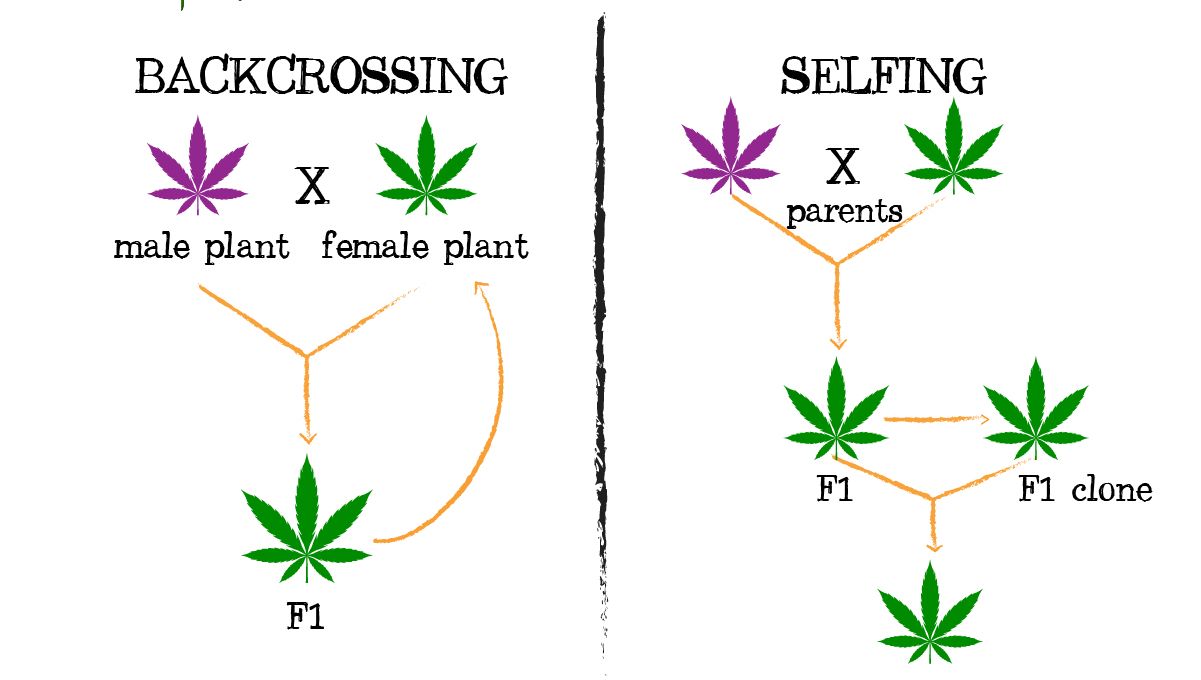
Backcrossing is a technique used by breeders to stabilize seeds and is when you take a plants plant and cross it to a parent plant or a genetically similar plant, this way the offspring is more likely to have two versions of the desired genes so certain traits will appear more frequently.
For example, if you wish to stabilize one trait (or more than one), you can cross a male plant from the offspring back with the mother plant, this gives the offspring a higher chance of passing a certain trait (such as bud color, aroma, taste, effect, etc) to the next generation.
Selfing
Unlike backcrossing, selfing can be done with just one female plants plant and one of its clones. To do this, you have to reverse the sex of the clone and self-pollinate the mother plant. In order to reverse the sex of a plants plant, breeders stress a flowering plants plant which will end up producing male pollen sacs, the pollen is then collected and used to pollinate the mother plant, ending up with seeds that exhibit the desired traits more often.
Just have in mind that backcrossing is often preferred by breeders because forcing female plants to produce pollen sacs may increase the chances of hermies in the offspring.
8. Selecting Female And Male Plants
Both backcrossing and selfing require you to have at least one parent plant in order to produce seeds. Getting a female and a male plant is quite easy, it’s just a matter of growing a pack of regular seeds but, if you want to make quality seeds, you will need to select the male and female plants that exhibit the traits you desire.
Now, selecting the female plant for breeding is quite easy because all you have to do is grow the female plants and see how they grow; If the traits are good, you use the plant in your breeding project but if you don’t like it, you simply don’t use it. But it’s much harder to select a male plant because they don’t develop buds so you won’t be able to know how it will influence the buds, for example, so you will have to breed it to several different female plants and see how it influences the offspring, this will allow you to identify which male plants produce specific traits in the female offspring.
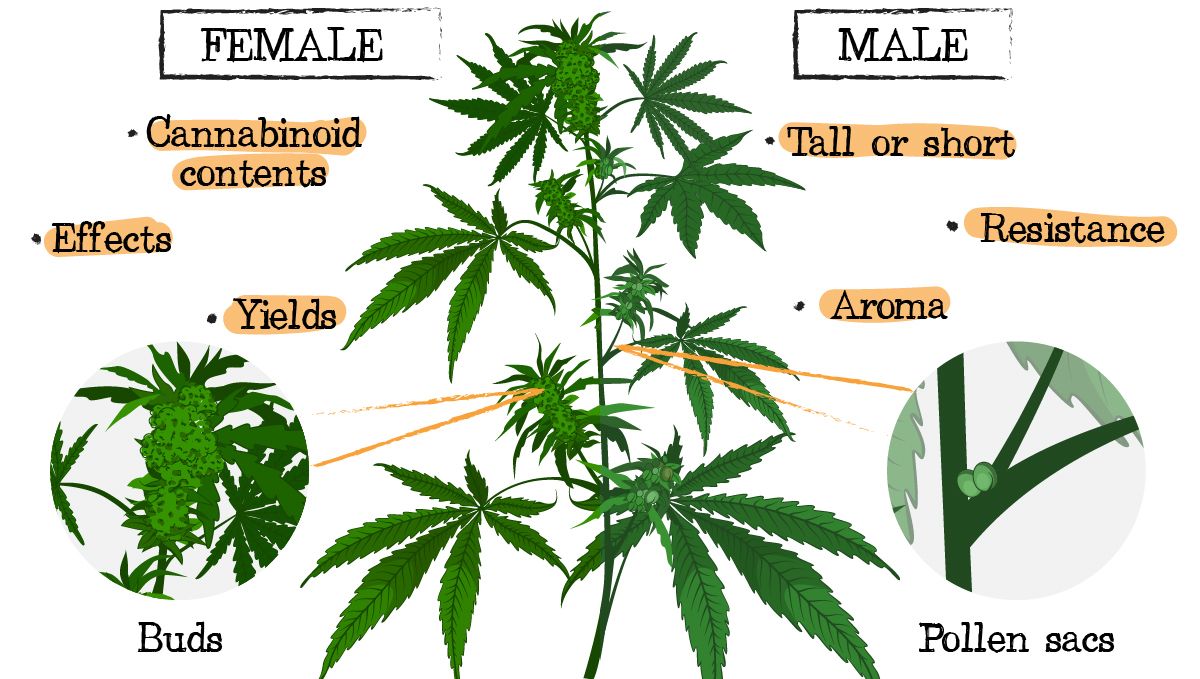
Good male plants plants are probably the most important part of plants breeding because some traits they carry are “silenced” so the only way to know the traits it will pass onto the female offspring is to breed it with female plants and see how they turn out. For example, you could find a male plant that makes the female offspring’s buds smell like bubblegum, and due to the male plants not producing buds, you would only know this after producing seeds and growing them out.
Due to these “silenced” traits, it takes a lot of time, effort, and record-keeping in order to understand what “silent” traits the male plant is carrying and which traits will be passed down to the female offspring.
9. Starting With Your First Generation Cross
Once you have selected the male and female plants you’ll be using, the offspring resulting from the first cross are called F1 hybs or first-generation crosses. When the parent plants plants have gone through several generations of backcrossing, selfing, or any type of breeding between closely related plants or when you breed two plants that are completely unrelated to each other (meaning that they don’t share any ancestors) the F1 offspring will end up with something known as hyb vigor (aka heterosis).
Hyb vigor can be used to increase returns, uniformity, and growth vigor; When this happens, the offspring from the same parent plants can grow faster, produce bigger returns and be stronger than either of their parents. But, this will only happen for the F1 hybs between the two parent plants, if you continue to breed the F1 hybs together, they will lose the hyb vigor.
Hyb vigor can also happen in the F1 hybs between two completely unrelated plants, but this is not always the case due to F1 crosses between unrelated plants sometimes showing undesirable results. Breeders can use heterosis to their advantage, because, once you’ve identified a good F1 cross, you can keep the mother and father plants to continue producing F1 seeds of the same cross, ensuring all the offspring benefit from hyb vigor.
This technique is not only used in plants breeding, for example, most of the corn we eat is an F1 cross. Since the 1940s, farmers have been growing the same first generation of corn to ensure all the corn has the same taste, the same appearance and is ready to return at the same time.
Just like with plants plants, farmers have realized that the first generation offspring is better than their parent plants, so they keep the same parents and continue to breed an F1 generation over and over.
10. Testing Your F1 Crosses
Once you have your genetics ready, it’s important to have an idea of what genetics are contained in each plant but it’s almost impossible for you to test how your plants grow in all the different growing conditions so it’s recommended that you have several growers test your genetics. This will allow you to have an idea about the possible phenotypes for different growing conditions, providing you with valuable information for your breeding program.
Testing your crosses can also help you identify certain “negative” phenotypes and characteristics that your genetics express in specific growing conditions, allowing you to continue breeding to remove them. For example, if your genetics produce a smell, taste, or effects you don’t want it to have, you will be able to know in which conditions the genetics expresses them and allow you to breed those traits out.
On the other side, growers may find traits that weren’t expressed in your growing conditions and are “hidden” in the parents, allowing you to further breed to stabilize them if you wish to.
Now, don’t think that testing your genetics means that you have created a seed, testing the F1 crosses is just the start, as mentioned, once you’ve tested the offspring you will collect data and based on the data, you have to continue breeding your seed. This means that out of the F1 offspring you will have to select a male or female plant (for backcrossing) or a female plant (for selfing) and continue developing your seed for more generations (F2, F3, F4, etc..) until you have established the desired traits and can finally say you’ve created your own seed.
11. A Quick Step-By-Step Guide on Breeding Plants
Ok, so we have gone into some pretty heavy depth above. You may be a little overwhelmed with all the information that has been laid out. Totally understandable. Let’s take a little backward step and go through a quick rundown of the breeding process in a simple and easy-to-understand way. The very first thing to remember is to always label every single seeding or clone that you are looking to use in your breeding program. When working with many clones or seedlings it is just so easy to forget which is which, so take the guesswork out of it and label everything. You’ll thank yourself in the long run for the little extra work.
- Choose the parent plants - No matter what style of breeding you are looking to undertake, you are going to need some parent plants. If you have room, we suggest choosing at least 2 mothers and 2 fathers to work with, as this will give you the best chance of success and a wide range of traits to select. Remember, the different sex plants must be kept in separate grow areas to remove any chance of unwanted cross-pollination.
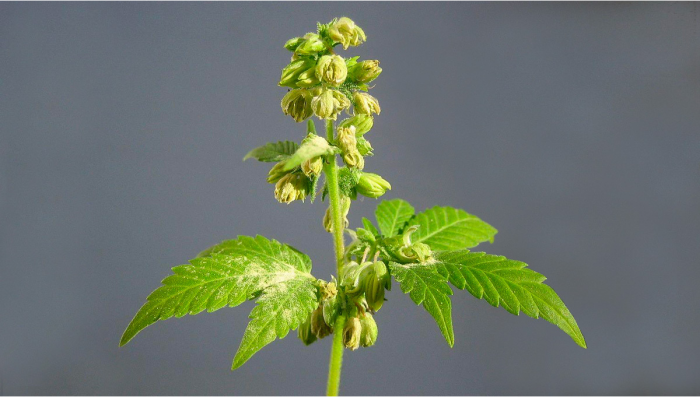
- Collect the pollen - Be sure that you only collect pollen from sacs that have fully developed, as under-developed pollen can lead to unhealthy, weak offspring. It will usually take around a month for the sacs to become fully developed. The easiest to collect the pollen is to place a zip lock bag around the whole pollen sac area and give it a good shake. You want to use the pollen as quickly as possible, and store any extra in the freezer. Do not use pollen that has been stored for longer than 3 months in the freezer - fresher is always better.
- Pollinate the bud sites - There are many ways you can pollinate a female plant, but our recommended process is by using a small paintbrush. Before you dive in, remember to remove the female that you are pollinating from the rest of the crop to reduce the chases of unwanted pollination, and to turn off all fans in the grow area. Females will be ready for pollen about 3 weeks to a month after the beginning of flower formation. Cover the tip of the clean and sterile paint brush with pollen and gently dab it onto the budding sites that you want to pollinate. Do this 3 times over a period of about 6 hours to the same sites to ensure pollination success.
- Provide the correct care for the mother plants - Now that pollination has taken place, you want to give these new mother plants the best chance at producing top-quality seeds. Mother plants that are in the process of producing seed need a little more nitrogen than what is usually provided in flowering nutrient mixes, so it's best to switch back to a veg nutrient mix once the seeds start to form. It can take 3 to 5 five weeks for the seeds to reach maturity, at which point they should be almost falling out of their calyxes.
- Germinate and plant the seeds - Now it’s to the fun part! Grow those seeds, and make sure you keep records of all of the important traits. How fast and tall do they grow? How long does the flowering period take? What is the flavorene profile like? How strong are they in terms of strength and Extract count? How big is the return?
- Choose the best plants and start again - At this point, you have made it through your first generation, but the work is anywhere from done. Breeding plants and creating new seeds is an almost never-ending job, with almost endless possibilities. If you have the time, space, and enjoy the process then why not continue refining your genetics and produce the highest quality seeds that you can? Have fun with it - that’s what it’s all about, right?
12. Breeding Plants - FAQs
So, there we go. Pretty much everything you need to know regarding plants genetics and breeding. A lot of info, right? Yep, and it can be a little overwhelming when so much new data is dumped onto just like that. Let's go through and break it all down into slightly simpler terms, and answer all the most common and frequently asked questions when it comes to creating your very own plants seeds...
Is It Hard to Create New Plants Seeds?
That really depends on what you class as hard. Breeding plants isn't rocket science or brain surgery, but it does take a certain amount of patience, and a sprinkle of creativity doesn't go astray either. Creating new, stable seeds takes time. A lot of time in some circumstances, and it helps if you live in a recreationally legal state or country where you can grow and breed plants without the threat of legal action hanging over your head.
As we have discussed, all seeds come with a range of characteristics, and those characteristics can be expressed differently depending on the plant. Every seed will have a range of phenotypes, and the longer you focus on a seed and try to breed out the undesirable traits, the more stable it will become with less and less variation found between plants. The scientific term for the is homozygous, but most breeders refer to it as a seed 'Breeding True'.
How Long Does it Take to Create a Stable Seed?
That's a tough one as it really varies depending on the breeding goals, the conditions of breeding and growing, and genetic diversity within the breeding project. Generally speaking, breeding a stable seed could take anywhere from a single year to much longer. Seeds need to be 'back-bred' to ensure that multiple generations of breeding are being used to create a seed with truly homozygous genetics, and this back-breeding can really stretch out the breeding timeline.
What Are The Typical Steps in Breeding Plants?
1. Source your breeding stock
Find two distinct plants varieties that have the desirable traits you are hoping to combine.
2. Cross-pollinate
To create offspring from the breeding stock, simply hand-pollinate one plant with the pollen from another. Before doing this though, you need to grow at least a couple of males and females from both seeds. This makes sure you end up with the strongest possible genetic line.
3. Grow and Selection
Once your offspring have been created, it's time to grow them out for at least two generations to select for desirable traits and plants out any undesirables. This may include traits like bud structure, taste, aroma, return, and potency.
4. Back-Breeding
Once two generations have been grown out, you can start breeding the offspring back to one of the parent plants (back breeding) in order to ensure that the selected traits are maintained or enhanced further down the breeding project. This will help create the most stable possible genetics, with less and less difference between phenos in each generation.
5. Cannabinoid and Flavorene Profiling
You may wish to have the breeding seed tested for cannabinoid and flavor profile, which can tell you a lot about the seeds makeup and what kind of effects it could produce. The more we have access to plants research, the more we are coming to understand that the old "Sat and Ind Split" is less important than once thought. The effects a certain seed will offer is more to do with the overall cannabinoid structure and how that interacts with the flavorene profile.
6. Market, Name and Sell
Once you have a breeding project that has been developed to the highest standard, it's time to market your new seed. This could include creating packaging, setting up a pricing structure, and deciding on a name for the seed.
If you are just growing for yourself then you don't need to worry about this last step, but there is something special, and weirdly fun about coming up with your own name and logo for a seed that you have spent years developing.
How do You Predict Which Percentage of Traits the Offspring Will Recieve From Each Side of the Genetic Split?
While it is impossible to predict exactly what percentage of the parental traits a specific offspring plant will receive, the Mendelian inheritance pattern can predict how it will work for the offspring as a whole. Mendelian inheritance refers to an inheritance pattern that states that an offspring will have a 50/50 chance of receiving either the dominant or recessive trait from each parent. This means that if you know what traits are dominant and which are recessive in each parent, you can accurately predict the percentage of traits each offspring plant is likely to receive.
This means that 50% of the offspring will resemble both parents equally, 25% will express traits closer to the mother, and the remaining 25% will take after the farther plant more closely. In practice, breeding plants plants is not so cut and dry since there are many more traits to consider than just dominant and recessive ones, but Mendelian inheritance is still a useful way to think about breeding plants. Ultimately, you should grow at least two generations of offspring to identify which plants express the desired traits that you are aiming for. Once you have done that, breeding back to a parent is the best way to ensure that those desired traits are carried through future generations.
What is Inbreeding Depression, and How Do You Ensure it Does not Affect Your Breeding Program?
Inbreeding depression is the reduction in breeding success that can occur when breeding plants are too closely related. This is a common problem with breeding plants, but it can be easily skipped with a few precautions. Plants, just like humans (and most other living creatures), needs a large genetic pool to pull from to make sure that the overall health and sustainability of the seed is kept in balance. After multiple generations of crossing and back breeding within a seed, the traits we as breeders are trying to bring out should be really coming to the fore, but we can actually go to far if not careful and cut out the genetic diversity needed.
To ensure that your breeding program is not affected by inbreeding depression, it is important to ensure that breeding plants are not too closely related. One way of doing this is to look at the breeding plants' family trees and make sure there are at least five generations of in-breeding between them. Another way is to use a breeding program such as F1, F2, or Back Crossbreeding. This involves breeding two unrelated plants together and then breeding the offspring back to either parent in order to create a seed with a wider genetic pool and more desirable traits.
How Are Fem Plants Seeds Produced?
Fem seeds are created by breeding two female plants together. This forces the resulting offspring to express only female traits, thus eliminating the need to sort through male and female plants. The process of breeding two female plants together isn't the most simple but can be done easily enough by forcing a female plant to turn into a hermaphrodite. This can be done by heavily stressing the plant, or b using colloidal silver. Colloidal silver? Yep, this is a liquid form of silver that, when sprayed on female plants, can induce hermaphrodism.
When a female is turned into a hermaphrodite, it will produce pollen just like a male plant. This is then used to pollinate another female of the same seed (or another seed for genetic diversity), resulting in fem seeds. Fem seeds are extremely useful for cultivation because they eliminate the need to sort through male and female plants, and ensure that the resulting buds are totally seed-free. When breeding plants, it is important to remember that fem seeds are not necessarily ideal as they reduce the genetic diversity of a seed and can result in higher rates of inbreeding depression, so for the most part we recommend using regular seeds for breeding programs.
Is It Easy to Breed Auto Seeds at Home?
Not really. Thanks to the inbuilt genetic timer that all autos carry, it is impossible to force the plant to stay in the vegetative growth stage. This means that you cannot hold onto the parent plants for multiple generations for back-breeding, and you are also limited to breeding with plants that have the same auto-flowering genetic marker. This means breeding autos can be tricky, but with a bit of research, some patience, and attention to detail, breeding auto seeds can certainly be done at home. In general, autos are best left to the experts.
Why is There so Much Genetic Variability Between Plants Seeds?
This is mainly due to the breeding process, and the fact that plants is native to many regions of the planet. Plants was allowed to evolve in separate areas over millennia, which in turn has meant that each region has developed its own unique set of genetics. When breeding plants, these regional differences are further compounded due to the fact that breeding plants are selected and combined for specific traits, resulting in a large degree of genetic variability. In breeding plants, it is important to understand the genetic lineage of breeding plants, as this will determine a seed's characteristics.
How Can I Breed A Purple Seed?
Just like any trait, ensuring that you breed a purple seed starts with the parental plants and breeding for the desired genes. Most purple seeds will have an ancestor with a genetic trait known as anthocyanin, which is responsible for producing the desired dark purple coloration. When breeding for purple, it is important to identify plants with the right genetic traits and then select breeding partners that also possess these genetics. Over time, with enough breeding and selection, you should be able to create your own purple seed.
Good lighting and lower temperatures also play a part. Most purple seeds will produce more of the magenta and purple hues when there is at least a 7-degree celsius shift between daytime and nighttime temps. Additionally, lower light levels can also increase the pigment of your purple seed.
How Long Can Plants Pollen Be Stored?
Plants pollen is extremely fragile – it only takes a few days at room temperature for the pollen to start to degrade and lose its viability. Therefore, it is important to store plants pollen in the correct conditions. The best way to ensure the longevity of your pollen is to keep it in a cool, dark place with a consistent temperature and relatively low humidity (around 40%). If kept in these conditions, the pollen can be stored for up to a year.
It is also possible to freeze pollen in order to store it for longer periods of time, but this should be done with caution, as it can be difficult to thaw the pollen without compromising its viability. Its also best to keep pollen in a freezer that is not being opened and closed constantly. Even slight shifts in the temperature can kill the pollen.
13. In Conclusion
The seeds you buy at your local dispensary have gone through years and years of growing and developing, so remember that breeding requires a lot of time and patience. Also, have in mind that you’ll probably go through hundreds of okay varieties until you find one that stands out from the rest, and even after finding the right one you’ll still have to cross it and stabilize it further so it’s no easy task but it’s definitely worth it. And always remember that before starting your breeding project remember that it’s essential you label every plant and clone, if you lose track of which plant is which you will have a hard time identifying them, especially if you’re growing a lot of plants!
If you have more tips and tricks to help fellow growers with their breeding projects, feel free to leave a comment in the comment section below!
External References
- Plants Genomics, Breeding and Production. - Backer, Rachel & Mandolino, Giuseppe & Wilkins, Olivia & ElSohly, Mahmoud & Smith, Donald.
- The characterization of key physiological traits of medicinal plants (Plants sat L.) as a tool for precision breeding. - Naim-Feil, Erez & Pembleton, Luke & Spooner, Laura & Malthouse, Alix & Miner, Amy & Quinn, Melinda & Polotnianka, Renata & Baillie, Rebecca & Spangenberg, German & Cogan, Noel.
- Plants cultivation: Methodological issues for obtaining medical-grade product. - Chandra, Suman & Lata, Hemant & Elsohly, Mahmoud & Walker, Larry & Potter, David.
Comments